
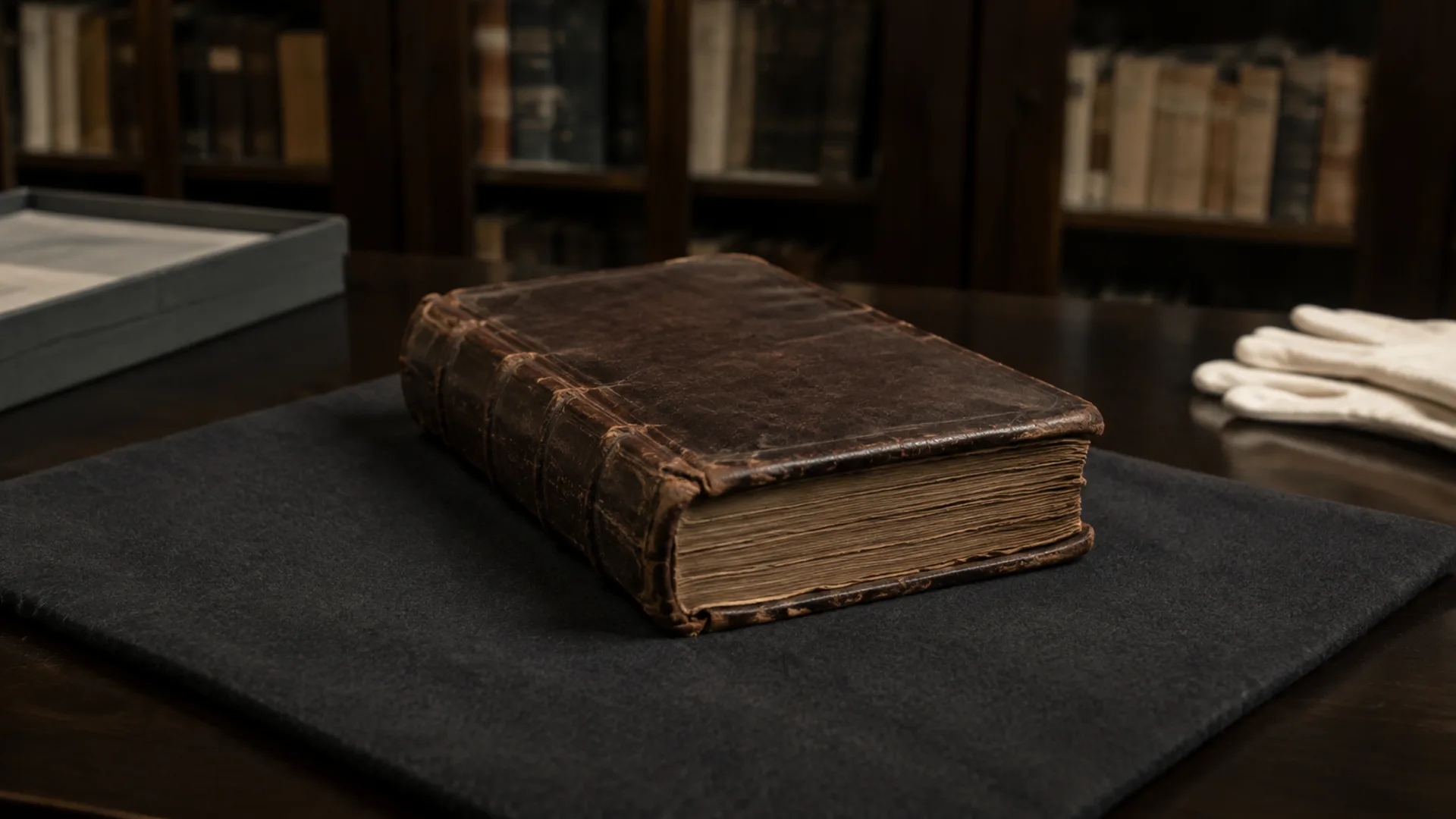
There is an old book filled with strange plants, celestial diagrams, and writing that looks far too organized to be random. The problem is that, after more than a century of attempts, no one has been able to demonstrate what it actually says.
The book that arrived with a question inside it
In 1912, bookseller Wilfrid Voynich acquired a manuscript that quickly drew attention for an unusual combination: the pages were illustrated, the material appeared old, and the text used signs that did not clearly match any known alphabet.
The name “Voynich” identifies the man who publicized the codex in the twentieth century, not its author. Before reaching him, the book had already passed through other hands, but its earlier journey is incomplete. That missing context turns every page into a clue without a caption.
There is an old, illustrated codex written in a system that has not been identified. Its origin, language, and purpose remain open questions.
Writing that seems to want to be understood
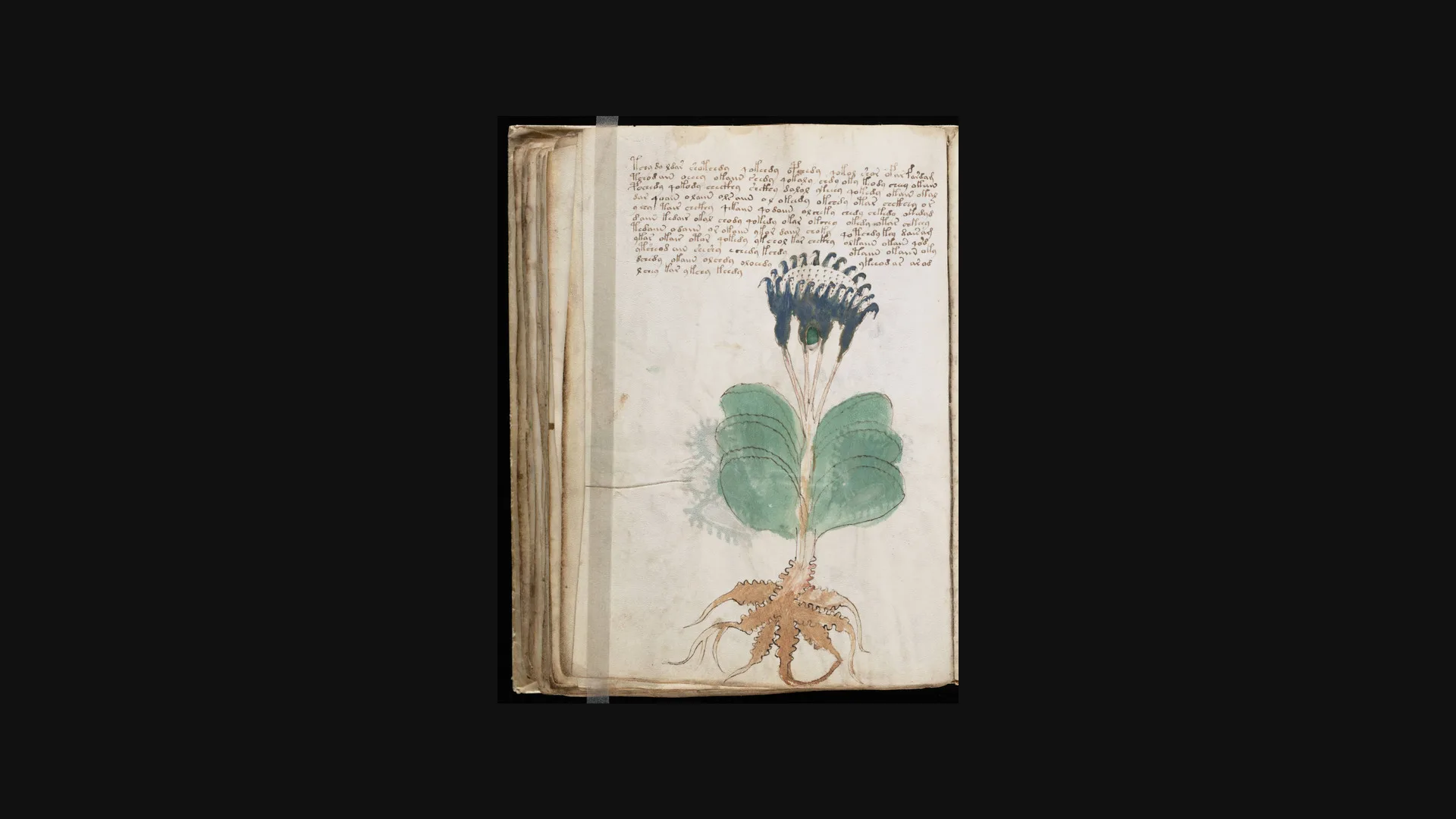
When we examine the lines, we can notice repetitions, groupings, and changes in the position of the symbols. This regularity suggests that someone followed a method, but it does not reveal what that method was.
The signs may represent letters, words, abbreviations, codes, or information units from a convention that disappeared. Finding patterns is not the same as finding meaning: very different systems can produce visually similar sequences.
Plants that do not solve the mystery
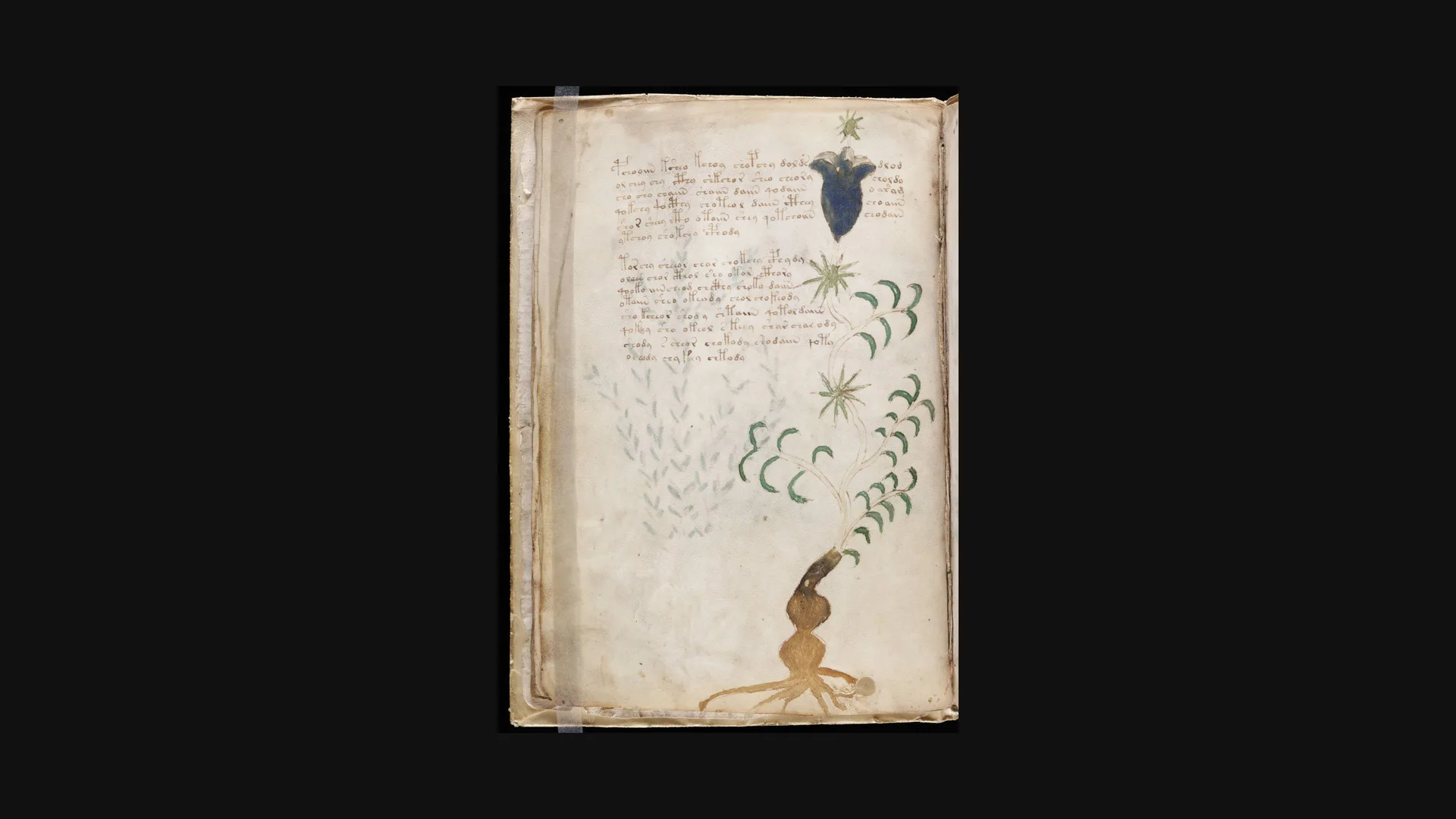
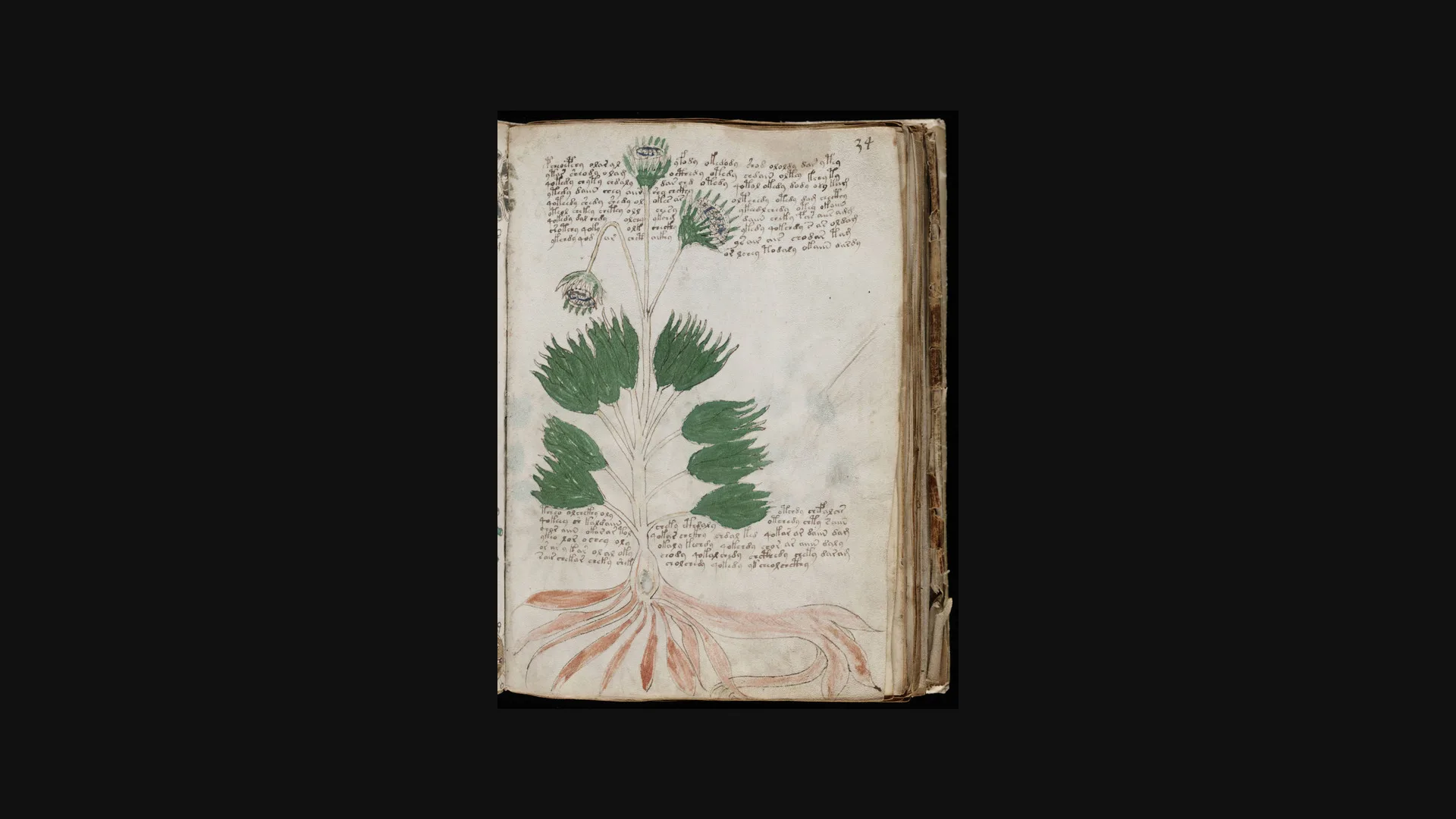
Much of the manuscript presents plants, roots, and structures that resemble a herbarium. Some images seem to contain recognizable natural elements; others do not clearly match known species.
One possible interpretation is that the author drew real plants imperfectly. Another is that the images belong to a symbolic or medical tradition that disappeared. They may also be partly invented. None of these hypotheses explains the entire book on its own.
Stars, circles, and the temptation to recognize everything
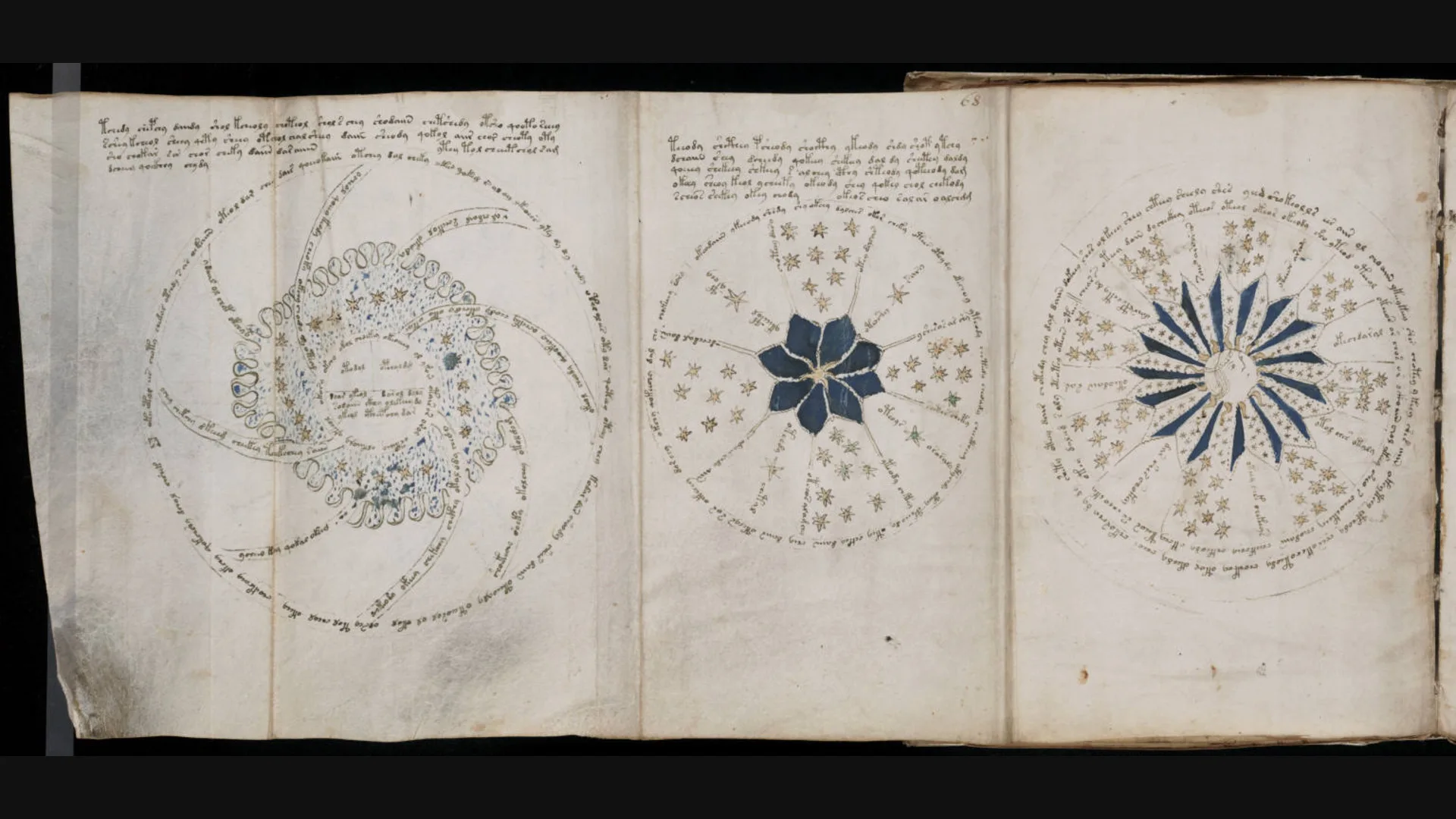
Other pages display circles, stars, and diagrams that resemble astronomy or astrology. The visual similarity is interesting, but it is not enough to identify the function of the drawings.
To support an interpretation, researchers must compare the manuscript with images, knowledge, and conventions genuinely available when it was produced. A similarity can guide an investigation, but it is not proof of origin or meaning.
The three hypotheses that keep returning
The best-known hypothesis says that the manuscript contains an encrypted message. In that case, researchers would need to find a key capable of explaining the symbols across different pages and producing a consistent reading.
Another possibility is that the text records a real language that left few or no known examples. The challenge would then be recognizing a language without a dictionary, speakers, or comparable texts.
It is also possible that the author created a private system to organize information. This would explain some of the regularity, but it would still have to account for the illustrations, the codex's size, and the relationship between its sections.
Finally, there is the fraud hypothesis: someone may have produced a mysterious object to sell secret knowledge to an impressionable buyer. It is a possibility, but it remains a hypothesis. The effort required to prepare, illustrate, and bind the book does not prove that a scam took place.
What the human figures add
The manuscript also contains human figures, bathing scenes, containers, and structures that may resemble body diagrams or medical practices. These images broaden the field of interpretation, but they do not provide a ready-made explanation.
We can recognize a shape without knowing what function it had in the original system. That is why a convincing translation would need to connect the text, illustrations, page organization, and historical context at the same time.
Why has it still not been deciphered?
The obstacle is not simply the lack of a translation. Before translating, we must discover what each symbol represents, where a unit of meaning begins and ends, and whether the text follows the rules of a language, a cipher, or another system.
A serious proposal must work across many pages, explain the repetitions, and allow other researchers to reproduce the result. Solutions based on a small passage may look impressive, but they fail when they face the rest of the codex.
Digital images make it possible to enlarge details without handling the original, which is now preserved by Yale University's Beinecke Rare Book and Manuscript Library. However, seeing the signs more clearly does not automatically reveal the meaning they had for the author.
The most honest conclusion
The Voynich Manuscript remains without an accepted translation because we still do not know the nature of the problem. It may be an encrypted message, a lost language, a private system, or an ingenious fabrication.
The evidence allows a more limited, and therefore stronger, claim: it is an old, illustrated codex written in a system that remains unidentified. Magic, extraterrestrials, and vanished civilizations belong to speculation, not to what has been demonstrated.
Perhaps the secret is not hidden in one isolated sentence, but in the method that organizes the entire book. Until that method is understood, every page will continue to look like an answer about to appear.
Frequently asked questions
Is the Voynich Manuscript really medieval?
Analysis of the parchment indicates that the material was produced in the early fifteenth century. This helps date the support, but it does not identify the author or explain when the codex was organized.
Has anyone translated the manuscript?
Several translations have been announced, but none has demonstrated consistent, reproducible rules accepted by specialists for the work as a whole.
Are the plants real?
Some may have been inspired by real plants, but many do not clearly match known species. Appearance alone cannot distinguish observation, stylization, symbol, and invention.
Could the book be a fraud?
It is a possible hypothesis, but it has not been proven. It would need to explain not only the writing, but also the material, illustrations, and organization of the codex.